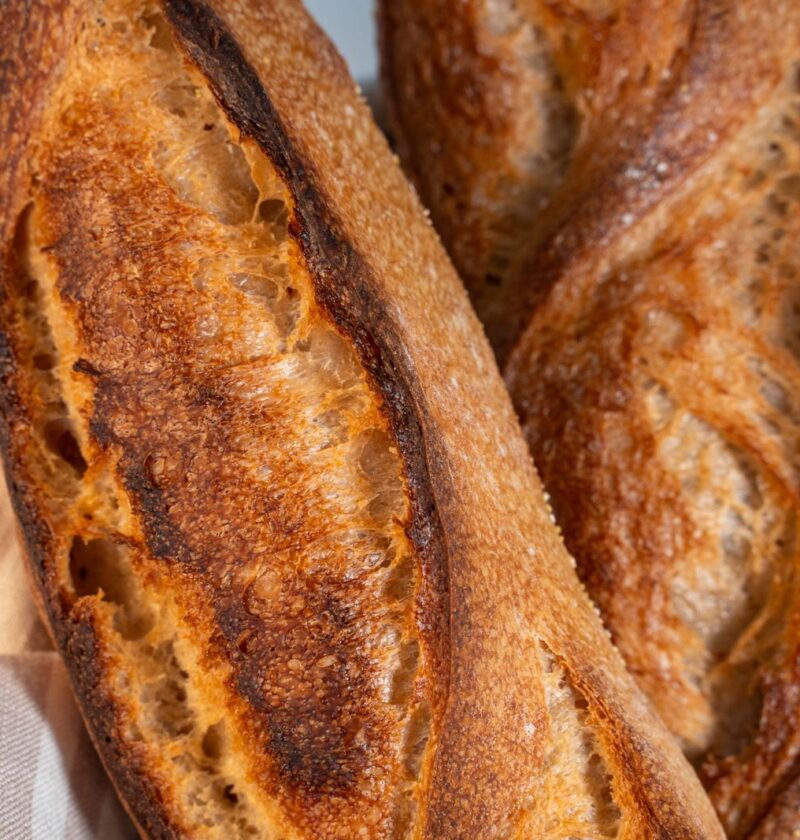
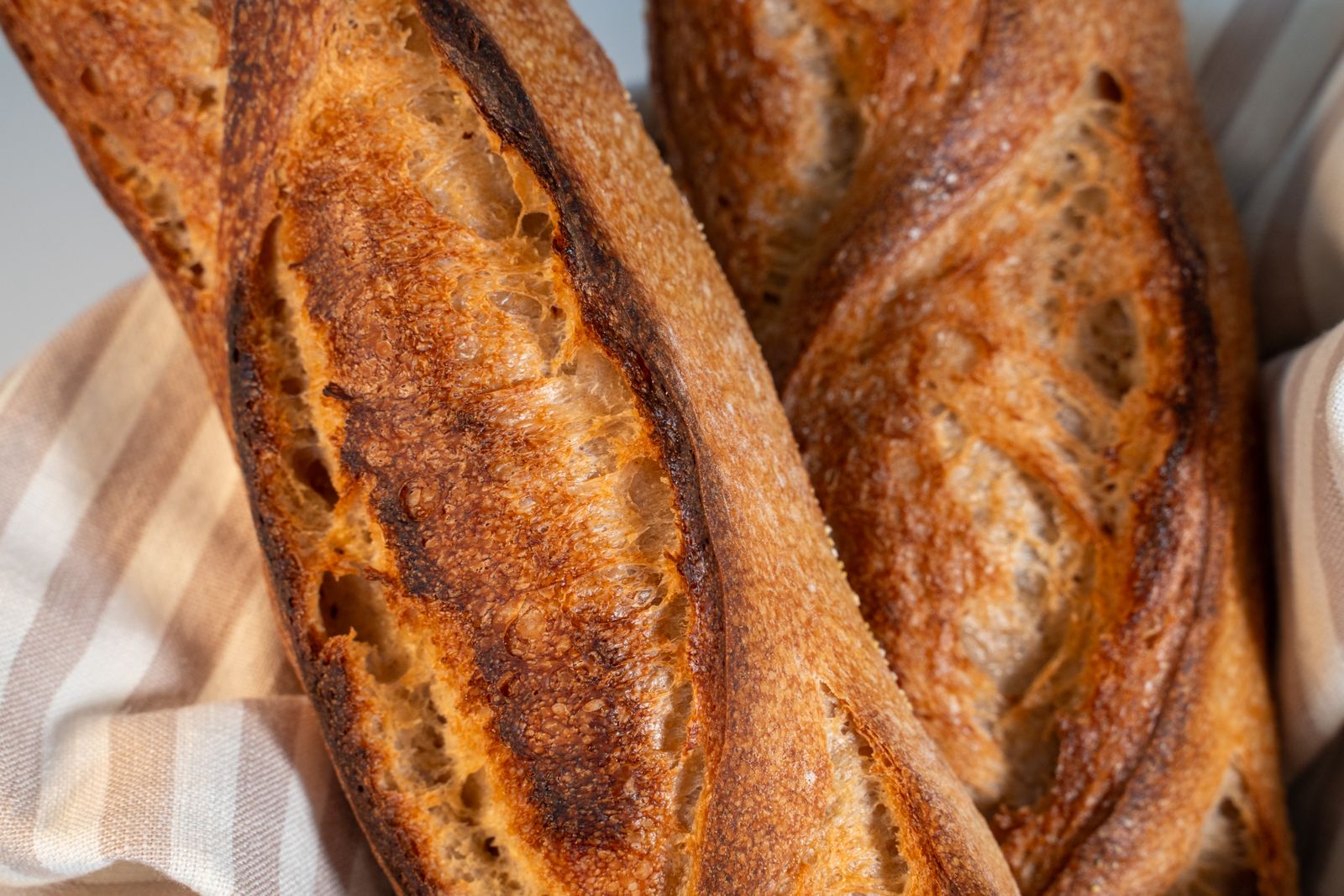

The baguette, with its crisp crust and airy crumb, is a symbol of France. The word baguette simply means “stick”, and long thin loaves became common in Paris in the early twentieth century.
A frequently told story links the baguette to a 1920 French law that banned bakers from starting work before four in the morning. A thin loaf bakes and proofs faster than a big round loaf, so bakers could have fresh bread ready for breakfast. Historians discuss how much the law really changed bread shapes, and other factors such as steam ovens and white flour also mattered.

Another tale says Napoleon’s soldiers wanted bread they could carry in trouser legs. This and similar stories are charming, but there is little evidence.
In 1993 a French decree, the Décret Pain, defined the traditional baguette: made on site from wheat flour, water, salt and yeast or leaven, with no additives or freezing. French people reportedly eat many millions of baguettes a day.
In 2022, UNESCO added the artisanal know-how and culture of baguette bread in France to its list of intangible cultural heritage. The honor recognized the skills of bakers and the daily rituals around fetching bread, as much as the loaf itself.
The story in more depth
Bread has been central to French life for centuries, and in the eighteenth and nineteenth centuries bread shortages and prices helped fuel revolutionary anger. Before the baguette, long loaves such as the pain long and the ficelle existed, and Vienna-style steam ovens introduced to Paris in the nineteenth century helped bakers make crusty bread with a light crumb. The thin shape suited quick baking and sale to customers who bought bread fresh every day.
After the Second World War, industrial baking spread and the quality of baguettes was criticized. In response, bakers, millers and the government worked to protect traditional methods, and the 1993 Décret Pain created the “baguette de tradition française”. Each year, the city of Paris holds the Grand Prix de la Baguette, where a winning baker earns the honor of supplying bread to the French president’s palace for a year.
France’s influence spread the baguette into other countries and cuisines. In Vietnam, the baguette arrived with French colonization and became the base for bánh mì, a sandwich made with a lighter, airy loaf and filled with pickles, herbs, pâté and meats. In Senegal, Algeria and Morocco, baguettes are an everyday bread. The baguette shows how a food tied to national identity can also be shared.
A timeline
- 1700s: Long loaves exist in Paris, and bakers learn new methods.
- 1839: August Zang opens the Boulangerie Viennoise in Paris.
- 1920: A French law restricts baking hours for bakers before 4 a.m.
- 1950s and 1960s: Industrial baking spreads and artisan bakeries decline.
- 1993: The Décret Pain defines the “baguette de tradition française”.
- 1994: The first Grand Prix de la Baguette in Paris is held.
- 2022: UNESCO recognizes baguette know-how and culture.
Regional styles and variations
- Baguette tradition: made with flour, water, salt and yeast or leaven, with no additives.
- Ficelle: a thinner “string” loaf.
- Pain de campagne: a country loaf, often with some rye or whole wheat.
- Bâtard: a shorter, thicker loaf.
- Bánh mì baguette: a lighter, airier Vietnamese baguette used for sandwiches.
- Flûte: a thicker baguette-type loaf.
Buying, tasting and choosing well
A good baguette has a thin, crackly crust, an open, slightly chewy crumb, and a wheaty, faintly sweet aroma. It is best the day it is baked, and by the next day it is better toasted or used for breadcrumbs and croutons. Bakers who mention a long fermentation or “levain” are often using more traditional methods. Store it in paper or cloth rather than plastic, which softens the crust.
Did you know?
- A traditional baguette typically weighs around 250 grams and measures about 55 to 65 centimeters.
- Parisians eat many millions of baguettes every day, according to estimates.
- The slashes on top, called grignes, let steam escape and bread expand.
- Baguettes are often bought daily, sometimes twice a day.
Eating it today
Even as bakeries close in some French villages, a movement of young artisan bakers is bringing back quality bread. Whether you buy one from a Paris boulangerie or bake it at home, the baguette is a lesson in how a few ingredients and good technique can make something special.
Countries connected to this story
- France: the home of the baguette, with a daily ritual of buying bread at the boulangerie.
- Vietnam: where the baguette became the base of the bánh mì sandwich.
- Senegal and North Africa: where baguettes are widely eaten as a legacy of French influence.
- Belgium and Switzerland: French-speaking regions with strong baguette and bakery traditions.
- Austria: whose Vienna steam-oven bakery methods influenced French bread-making.
Where to try it
- Du Pain et des Idées (Paris, France): a well-known bakery in the 10th arrondissement.
- Maison Kayser (Paris and worldwide): a bakery brand founded by Éric Kayser.
- Poilâne (Paris, France): a famous bakery known for its sourdough miche loaf.
- Le Grenier à Pain (Paris, France): a bakery that has won the Grand Prix de la Baguette.
These are well-known examples, not paid recommendations or rankings, and places change. Check opening times and details before you travel.
Well-known brands
- Paul: a French bakery chain founded in Lille in 1889, with locations in many countries.
- Brioche Dorée: a French bakery-café chain.
- Grands Moulins de Paris: a French flour miller.
- Maison Kayser: a bakery chain with shops in several countries.
Brands are named as widely known examples of makers, not as endorsements.
Related: Bread and baguette and Tomato Bruschetta.
Many food origins are disputed. This story summarizes commonly cited accounts as an introduction, not the final word.
Photo credits: Manish Jain on Pexels; Sebastian Luna on Pexels; Skyler Ewing on Pexels. Free stock photos shown as illustrations only.


