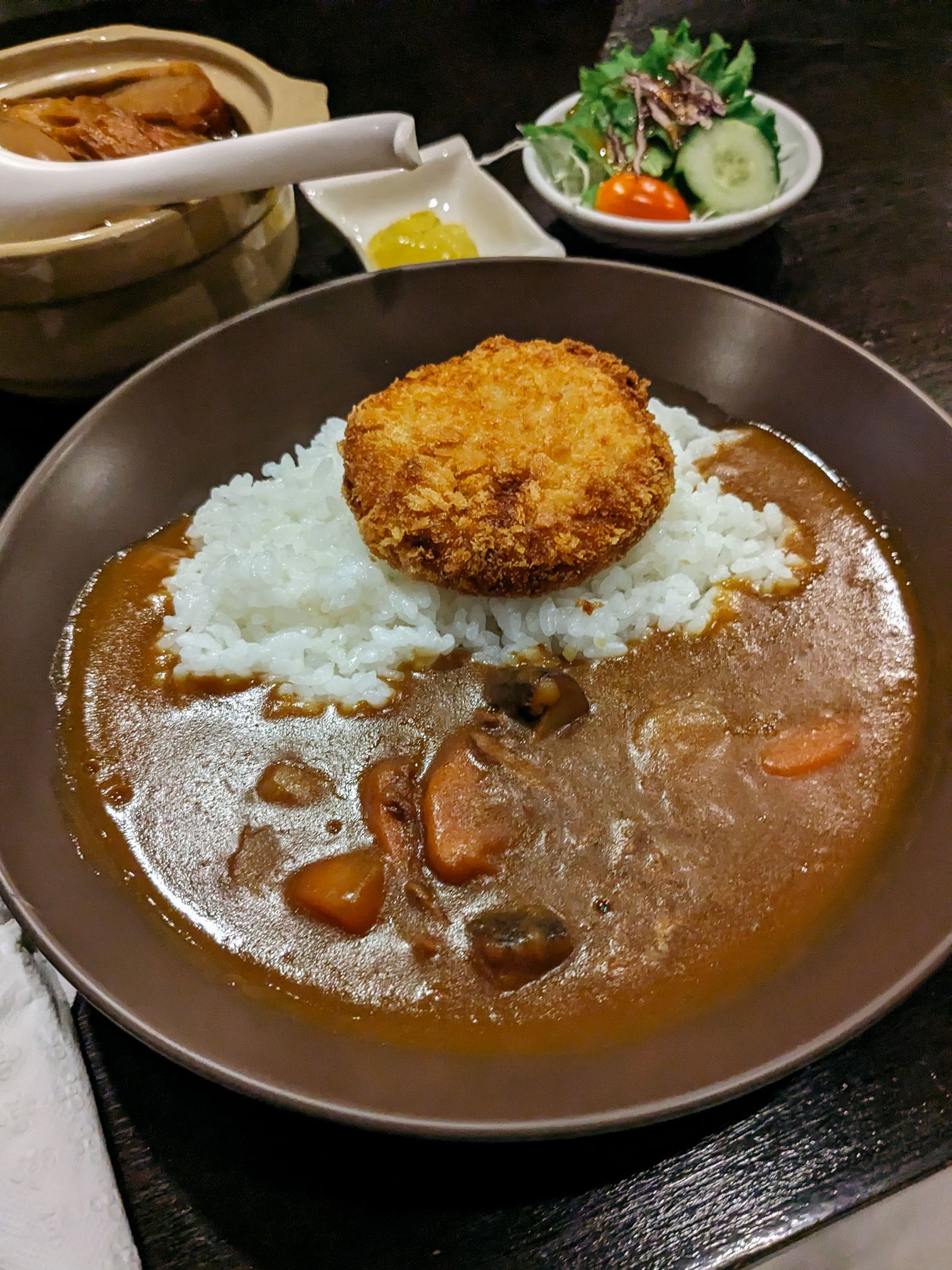

Japanese curry (karē) is mild, thick and slightly sweet, usually served over rice with potatoes, carrots and onions. It is very different from Indian curries, and its story begins with British sailors and traders.
Curry powder was popular in Britain in the nineteenth century, and a common account says it reached Japan in the Meiji era, after Japan opened to the world in the 1850s and 1860s, through the British Royal Navy and foreign settlers. The Japanese navy is often said to have adopted curry rice as a convenient and nourishing meal for sailors.

Over time cooks made the dish their own. Thickening it with flour and butter, a method taken from European stews, made the sauce silky. Commercial curry powder from Japanese companies appeared in the early twentieth century, and solid curry roux blocks, which dissolve in hot water, became popular in the 1950s and 1960s.
Curry rice also became a school lunch staple in postwar Japan. For many Japanese people it is the flavor of childhood, alongside dishes such as miso soup and rice balls. It is often served with pickled vegetables called fukujinzuke.
Variations include katsu curry, with a breaded fried cutlet on top, and curry udon. As with many foods, the dish’s journey shows how an ingredient or idea can travel across the world and become something quite new.
The story in more depth
The journey of curry to Japan is part of a larger story of how the Meiji era, which began in 1868, brought Western ideas, clothes and food into Japan. Curry came with the British, who had themselves adopted it from India, and was recorded in Japanese cookbooks by the 1870s. Early recipes included ingredients such as frogs and onions, which seemed exotic, and curry was a symbol of modern, Western dining.
Over the following decades, Japanese companies standardized curry. House Foods and S&B introduced curry powders and, after the war, roux blocks that cooks could drop into a pot with vegetables and meat. Japanese curry is thicker than most Indian curries and slightly sweet, often with apple, honey or chocolate. Many Japanese eat curry rice as often as once a week.
Variations include katsu curry, curry udon and curry bread (kare pan), a fried bun filled with curry. Curry became a staple of the Japan Maritime Self-Defense Force, where Friday is traditionally curry day. Japanese curry has also spread across Asia and to Western countries, including to Britain where katsu curry is a staple of the restaurant chain Wagamama.
A timeline
- 1850s and 1860s: Japan opens to foreign trade.
- 1872: Early Japanese cookbooks include curry recipes.
- Early 1900s: Curry powder is sold commercially in Japan, and companies such as House Foods and S&B follow in the 1920s.
- 1927: Nakamuraya in Tokyo begins serving an Indian-style curry.
- 1950s: Curry roux blocks become common.
- 1960s and 1970s: Curry rice becomes a school lunch and home staple.
- Today: Japanese curry is exported across Asia and beyond.
Regional styles and variations
- Karē raisu: the classic curry with rice.
- Katsu curry: curry with a breaded cutlet.
- Curry udon: curry sauce with thick noodles.
- Kare pan: a fried bun filled with curry.
- Soup curry: a thin, spicy curry from Sapporo.
- Naval curry: curry traditions linked with the navy, such as in Yokosuka.
Buying, tasting and choosing well
Choose curry roux to match your tolerance for heat, and add apple, honey or a little chocolate for depth. Cook the onions slowly until sweet, and let the curry rest so that flavors blend. Serve with short-grain rice and pickles. Making the sauce from scratch with spices gives you control over salt and flavor.
Did you know?
- Many Japanese families have a favorite brand of curry roux.
- Curry is often called a “national dish” of Japan.
- The red pickles served with curry are called fukujinzuke.
- Curry is regularly cited as one of Japan’s most popular foods.
Eating it today
Japanese curry is a comfort food, easy to make and easy to share. For a taste of Japan’s home cooking, it is a good dish to start with.
Countries connected to this story
- India: the source of curry spices and dishes.
- United Kingdom: which adapted Indian curry and brought it to Japan in the nineteenth century.
- Japan: where karē became a national comfort food.
- Taiwan and South Korea: places where Japanese curry has become popular.
- United States: where Japanese curry houses and ready-made blocks are sold.
Where to try it
- CoCo Ichibanya (Japan and worldwide): a large curry house chain with customizable spice levels.
- Nakamuraya (Shinjuku, Tokyo, Japan): a bakery and restaurant known for its Indian-style curry introduced in 1927.
- Curry houses of Kanda (Tokyo, Japan): a neighborhood known for many curry restaurants.
- Yokosuka naval curry (Yokosuka, Japan): a city linked to naval curry traditions.
These are well-known examples, not paid recommendations or rankings, and places change. Check opening times and details before you travel.
Well-known brands
- House Foods: a Japanese company known for curry roux, including Vermont Curry.
- S&B Foods: a Japanese spice and curry company that makes Golden Curry.
- Glico: a Japanese company that sells curry roux and other foods.
- Wagamama: a restaurant group serving katsu curry in many countries.
Brands are named as widely known examples of makers, not as endorsements.
Many food origins are disputed. This story summarizes commonly cited accounts as an introduction, not the final word.
Photo credits: Markus Winkler on Pexels; L. Lum on Pexels; Rockwell branding agency on Pexels. Free stock photos shown as illustrations only.