
People have enjoyed cold desserts for thousands of years. Ancient texts mention snow and ice flavored with fruit or honey in Persia, China and Rome. In the Arab world, sweet iced drinks called sharbat gave us the words sherbet and sorbet.
Sicily, which was ruled by Arabs for a few centuries, is often linked to the early Italian frozen desserts. Techniques for making ice with salt and snow spread across Italy during the Renaissance. A legend credits the Florentine architect and engineer Bernardo Buontalenti with serving an early gelato at a Medici feast in the sixteenth century. As with many origin tales, the details are uncertain.

In France, Sicilian chef Francesco Procopio dei Coltelli opened Café Procope in Paris in the late seventeenth century and helped popularize ice cream. During the following centuries, ice cream and sorbet became popular in Europe and the United States, and the invention of ice machines and cones in the nineteenth and twentieth centuries made them widely available.
Italian gelato differs from American ice cream. It usually has less fat and less air, and is served a little warmer, which gives a denser, more intense flavor.
Today you will find ice cream in countless forms, from Indian kulfi and Japanese mochi ice cream to Turkish dondurma. Each tradition shows how different cultures found their own ways to turn milk, sugar and ice into a treat.
The story in more depth
Gelato and ice cream are often confused, but they differ in air, fat and temperature. Gelato is churned more slowly, so it has less air and a denser, silkier texture, and it is served at slightly warmer temperatures than ice cream. Traditional gelaterie make it fresh in small batches, with flavors such as pistachio, hazelnut, stracciatella and fior di latte.
The story of frozen desserts includes a search for ice. Before refrigeration, ice and snow were cut from mountains and stored in ice houses. In Italy and Sicily, snow from Mount Etna was used for sorbetto and granita, which are still a Sicilian summer tradition. In the nineteenth century, hand-cranked ice cream makers, patented by Nancy Johnson in the United States in 1843, and later commercial refrigeration made ice cream widely available.
The cone is another milestone. Italian immigrants such as Italo Marchiony in New York have been credited with early cone patents, and ice cream cones became popular after the 1904 World’s Fair in St. Louis, according to many accounts. In the twentieth century, brands of industrial ice cream, from the American Baskin-Robbins to the Indian Amul, sold frozen desserts across the world.
A timeline
- Ancient times: Snow and ice are flavored with fruit and honey in Persia and China.
- 1500s: Italian courts serve early frozen desserts.
- 1686: Café Procope opens in Paris.
- 1843: Nancy Johnson patents a hand-cranked ice cream maker.
- 1904: The ice cream cone gains popularity at the St. Louis World’s Fair.
- 1920s to 1950s: Industrial ice cream and refrigeration spread.
- Today: Ice cream is made worldwide, with artisan gelato popular in Italy and abroad.
Regional styles and variations
- Gelato: dense, lower in air and fat, served slightly warmer.
- Sorbetto and granita: fruit ices from Italy.
- Kulfi: an Indian dense, frozen milk dessert.
- Dondurma: Turkish stretchy ice cream.
- Soft serve: light ice cream dispensed from a machine.
- Mochi ice cream: Japanese ice cream wrapped in rice dough.
Buying, tasting and choosing well
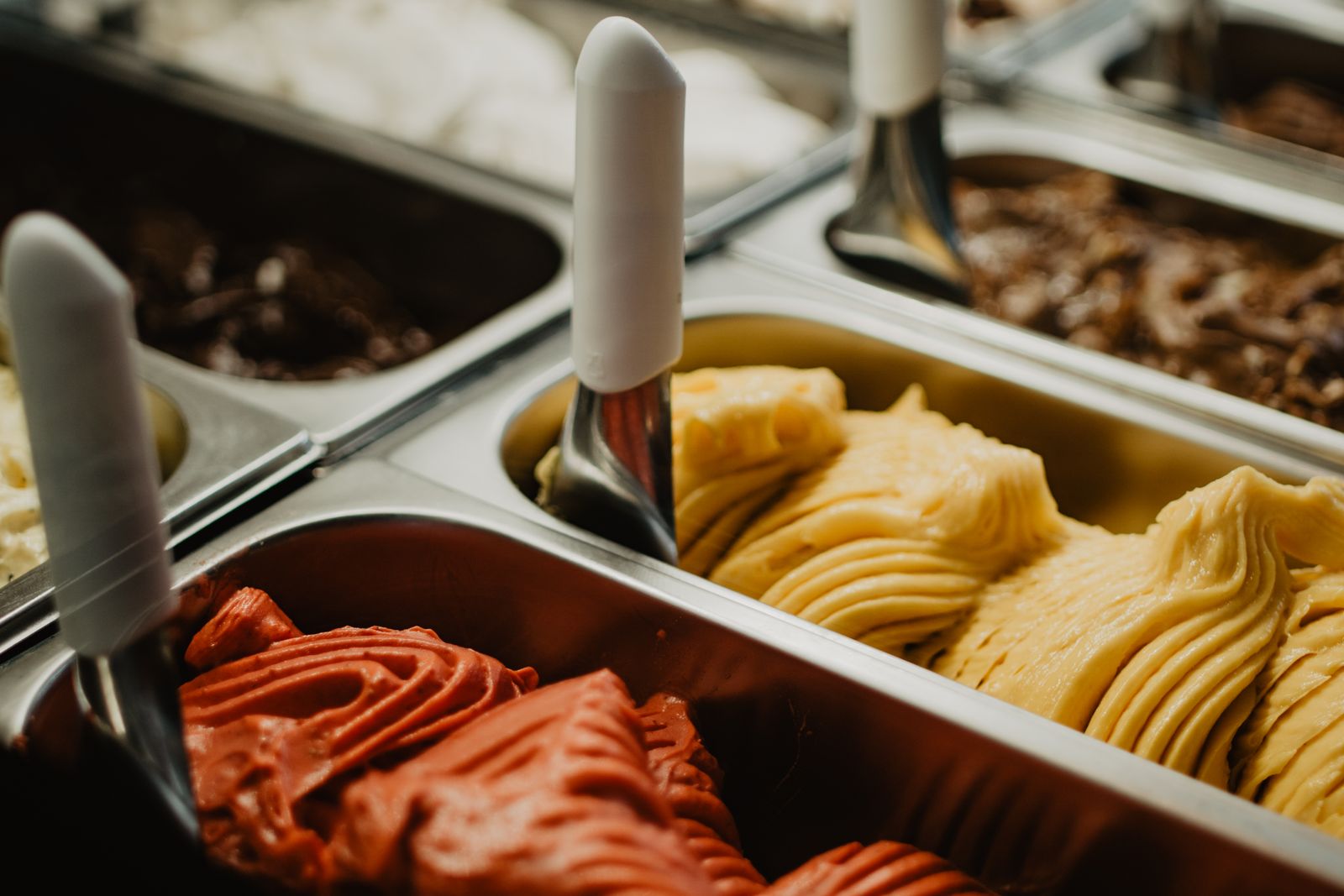
In a good gelateria, look for natural colors, such as a muted pistachio green rather than neon, and flavors stored in covered containers, which suggests fresh batches. Taste small samples. The best gelato is eaten soon after it is made, and flavors that reflect the season, such as fruit in summer, tend to be fresh. Avoid mountains of swirled gelato piled high, which can indicate a lot of air or stabilizers.
Did you know?
- Gelato has less butterfat than American ice cream.
- The word gelato simply means “frozen” in Italian.
- Sicily is known for eating gelato in a brioche bun.
- Pistachio from Bronte in Sicily is considered a prized flavor.
Eating it today
Ice cream has become both an everyday treat and an art. Trying a local flavor is a good way to taste a place: pistachio in Sicily, kulfi in Delhi, and dulce de leche in Buenos Aires.
Countries connected to this story
- Italy: the home of gelato, with a gelateria in nearly every town.
- France: where Café Procope helped make ice cream fashionable.
- Iran and the Arab world: sources of early sherbets and frozen sweets.
- United States: where ice cream became an industry and where the cone became popular.
- India: known for kulfi, a dense, frozen dairy dessert.
- Turkey: with its stretchy, chewy dondurma.
- Japan: which has mochi ice cream and matcha flavors.
Where to try it
- Gelateria Vivoli (Florence, Italy): a historic gelateria, in business since 1929.
- Giolitti (Rome, Italy): a famous gelateria, open since 1900.
- Gelateria Dondoli (San Gimignano, Italy): a gelateria led by a champion gelato maker, Sergio Dondoli.
- Café Procope (Paris, France): a historic café often linked to the early history of ice cream in France.
These are well-known examples, not paid recommendations or rankings, and places change. Check opening times and details before you travel.
Well-known brands
- Häagen-Dazs: an American ice cream brand founded in 1960.
- Ben & Jerry’s: an American brand that began in Vermont in 1978.
- Magnum: an ice cream bar brand launched in 1989.
- Amul: an Indian dairy cooperative that sells ice cream.
- Baskin-Robbins: an American ice cream chain founded in 1945.
Brands are named as widely known examples of makers, not as endorsements.
Related: Vanilla spice page and milk.
Many food origins are disputed. This story summarizes commonly cited accounts as an introduction, not the final word.
Photo credits: ROMAN ODINTSOV on Pexels; Engin Akyurt on Pexels; Liudmyla Shalimova on Pexels. Free stock photos shown as illustrations only.