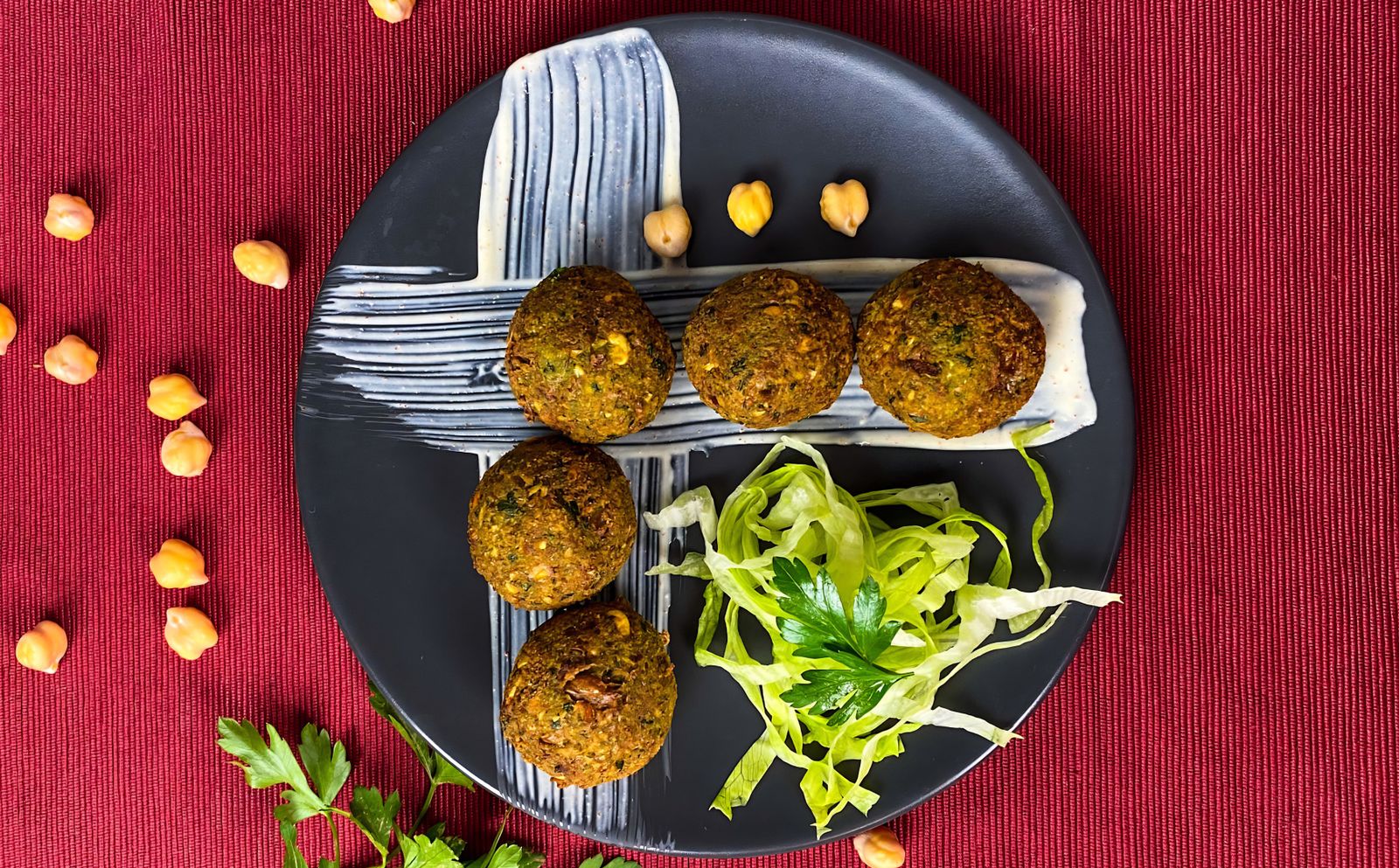
Falafel are deep-fried balls or patties of ground legumes and herbs, served in flatbread with salad and tahini sauce. They are sold on street corners from Cairo to Beirut, Jerusalem to Istanbul, and are now popular worldwide as a vegetarian food.
Their history is debated. A common theory places their origin in Egypt, where a similar fritter called ta’amiya is made with fava (broad) beans. One account suggests it was made by Coptic Christians as a meat-free food during Lent. This is a widespread theory, but proof is limited.

As the dish spread north to the Levant, cooks began using chickpeas instead of fava beans, since chickpeas grew well there. Today, Egyptian falafel is typically made with fava beans and is green inside, while Levantine versions use chickpeas or a mix.
The key to light falafel is to use soaked, uncooked dried chickpeas rather than canned or cooked ones. Fresh parsley and cilantro, onion, garlic, cumin and coriander give the green color and fragrance.
Falafel is claimed as a national dish by several countries, which is a common feature of foods that cross borders. In many places it is simply everyday street food, and an easy way to enjoy a plant-based meal.
The story in more depth
In Egypt, ta’amiya is typically eaten for breakfast with bread, salad and tahini, and is made from split dried fava beans, herbs and spices. The fava-based version is lighter, greener inside and is also known in Alexandria. The name means “food” in Arabic, hinting at its role as the people’s staple. As the dish moved to the Levant, chickpeas replaced fava beans, and the name falafel, which may come from an Arabic word for pepper or a word meaning “pebbles”, became widespread.
In the twentieth century, falafel became a street food in cities such as Jerusalem, Haifa, Beirut and Damascus. In Israel, it was adopted by many communities, including Jewish immigrants from Yemen and Iraq, and became a national food. In Europe and North America, falafel arrived with immigrant communities and became popular in vegetarian and vegan cooking. In Germany, Sweden and the United Kingdom, it is found at fast food stalls.
Falafel is now made in many forms: baked, air-fried, with beetroot or herbs, or in a wrap. The classic is deep-fried with sesame seeds, and is served with pickled turnips, tomatoes, cucumber, and tahini or amba, a pickled mango sauce.
A timeline
- Possibly 1800s or earlier: Ta’amiya made from fava beans is eaten in Egypt.
- 1900s: Chickpea falafel spreads in the Levant.
- 1940s and 1950s: Falafel becomes a common street food in Israel and Palestine.
- 1970s: Falafel reaches Europe and North America.
- 2000s: Vegan and vegetarian cooking boosts its popularity.
- Today: Falafel is a global street food.
Regional styles and variations
- Egyptian ta’amiya: made with fava beans and fresh herbs.
- Levantine falafel: made with chickpeas, often with parsley and coriander.
- Baked falafel: a lower-oil version.
- Falafel sandwich: served in pita with salad and tahini.
- Falafel bowls: served over rice or salad.
Buying, tasting and choosing well
Good falafel is crisp outside, green and fluffy inside. Use soaked, raw chickpeas, never canned, and fresh herbs, and let the mixture rest. Fry at the right temperature so that they do not absorb too much oil, and serve right away. For the best experience, try them in a place that makes them to order.
Did you know?
- Falafel is naturally vegan, depending on the sauce.
- The balls are often rolled in sesame seeds.
- Some say the word falafel comes from an Arabic word for pepper.
- Falafel is often eaten with pickled turnips and tahini sauce.
Eating it today
Falafel is one of the world’s best street foods and a wonderful way to eat plant-based. At home, try making your own, with soaked chickpeas and lots of fresh herbs.
Countries connected to this story
- Egypt: where ta’amiya is made from fava beans and is a national breakfast.
- Lebanon and Syria: where chickpea falafel is common.
- Israel and Palestine: where falafel is a street food staple.
- Jordan: with a strong falafel and hummus culture.
- Germany and Sweden: where falafel is commonly served in kebab-style shops.
- United States: where falafel became popular through Middle Eastern restaurants and vegetarian cooking.
Where to try it
- Felfela (Cairo, Egypt): a long-running restaurant known for ta’amiya and Egyptian dishes.
- Falafel Hakosem (Tel Aviv, Israel): a well-known falafel stand.
- Sahyoun (Beirut, Lebanon): a well-known falafel sandwich shop in the city.
- Hashem (Amman, Jordan): a famous, simple restaurant serving falafel and hummus in downtown Amman.
These are well-known examples, not paid recommendations or rankings, and places change. Check opening times and details before you travel.
Well-known brands
- Cedar’s: an American brand of Mediterranean foods.
- Telma: an Israeli brand of falafel mix.
- Al Wadi Al Akhdar: a Lebanese brand of pickles and foods sold abroad.
Brands are named as widely known examples of makers, not as endorsements.
Related: Falafel recipe and chickpeas.
Many food origins are disputed. This story summarizes commonly cited accounts as an introduction, not the final word.
Photo credits: Anton Uniqueton on Pexels; Smitha Nittur on Pexels; Ali Dashti on Pexels. Free stock photos shown as illustrations only.