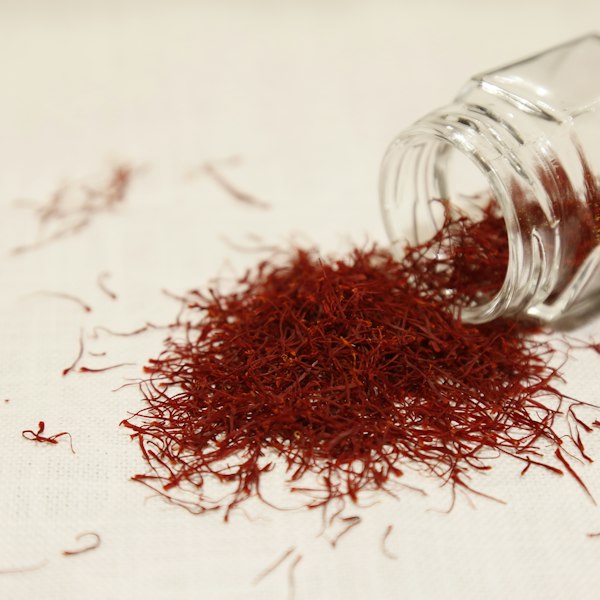
Saffron is made from the dried red stigmas of the saffron crocus, Crocus sativus. Each flower produces only three of these threads, and they must be picked by hand, usually in a short harvest window in autumn. It takes on the order of one hundred and fifty thousand flowers to make a kilogram of saffron, which explains its high price.
The plant is a sterile triploid, meaning it cannot reproduce by seed and has been propagated by bulb for thousands of years. Its origins are usually traced to Greece or Southwest Asia. Saffron was used in ancient Persia, Egypt, Greece and Rome as a dye, perfume, medicine and flavoring.

Iran produces the majority of the world’s saffron, with Spain, Kashmir in India, Morocco and Greece also known for it. Pampore in Kashmir and La Mancha in Spain are famous for their crops, and some regions have protected names.
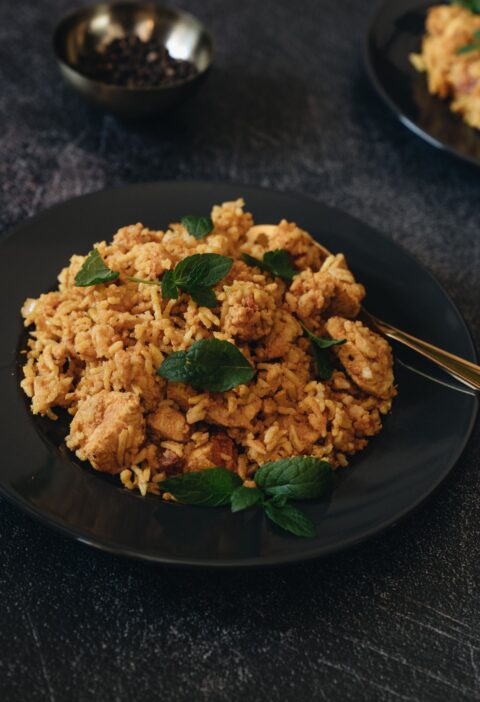
In the kitchen, saffron is used in Spanish paella, Italian risotto alla Milanese, Persian rice dishes, Indian biryani and desserts, and breads such as Cornish saffron buns. A pinch steeped in warm water or milk releases color and aroma.
Because of its price, saffron is often adulterated, so buy from reputable sources and look for whole threads instead of powder. A little goes a long way.
The story in more depth
Evidence of saffron use stretches back thousands of years. Wall paintings in the Bronze Age settlement of Akrotiri on the island of Santorini show figures gathering crocus stigmas, and ancient Persians used saffron in dyes and food. Greek and Roman texts describe it as a perfume, scattered in theaters and in baths, and a medicine. The Arab world helped bring saffron to Spain in the Middle Ages, where it became a key ingredient.
Saffron was so valuable that it was sometimes adulterated, and in some European cities, such as Nuremberg in the fifteenth century, laws punished those who mixed it with other materials. Today, concern about fake saffron remains, with cheap versions made from dyed corn silk or safflower. A trusted source, whole threads and a deep red color with orange tips are good signs.
Saffron features in many culinary traditions: Spanish paella; Italian risotto alla Milanese, which tradition links with the decoration of Milan’s cathedral; Persian tahdig rice; Indian biryani, kheer and kesar milk; Moroccan tagines; Swedish saffron buns at Christmas; and Cornish saffron cake. Its aroma is honeyed and floral, with a faintly bitter edge.
A timeline
- About 3,500 years ago: Crocus gatherers are painted on walls at Akrotiri on Santorini.
- Ancient Persia: Saffron is used in dyes, perfumes and cooking.
- Roman period: It is used as a perfume and a flavoring.
- Middle Ages: Arab traders help bring saffron to Spain, and European growers plant it.
- 1400s: Nuremberg enforces a “Safranschau” to punish adulterated saffron.
- Today: Iran produces the large majority of the world’s saffron.
Regional styles and variations
- Negin and Sargol: Iranian grades of high-quality saffron.
- La Mancha saffron: a Spanish saffron with a protected designation.
- Kashmiri mongra saffron: a prized variety from India.
- Saffron milk: threads steeped in warm milk for biryani and desserts.
- Saffron in rice: a classic technique in Persian chelow and Spanish paella.
- Powdered saffron: convenient but easier to adulterate.
Buying, tasting and choosing well
Buy whole threads, which should be deep red, dry and aromatic, with little yellow or white. Steep a pinch in a few tablespoons of warm water or milk for 15 to 20 minutes before adding it to a dish. Very cheap saffron is often fake. Store it in an airtight container away from light. A little goes a long way: a pinch is enough for a dish for four.
Did you know?
- Each crocus flower produces only three stigmas.
- The harvest is short, and the flowers must be picked at dawn before they wilt.
- Saffron’s scent comes mostly from safranal, and its color from crocin.
- Saffron is used in some traditional medicines, but large amounts can be harmful, especially in pregnancy.
Eating it today
Saffron is a reminder of the labor behind food. Using it with care, a few threads at a time, makes it affordable, and buying from known sources supports the families who harvest it by hand.
Countries connected to this story
- Iran: the world’s largest producer, mostly in the Khorasan region.
- Spain: known for La Mancha saffron and paella.
- India: where Kashmir’s Pampore area grows famous saffron.
- Greece: where Kozani produces saffron with a protected name.
- Morocco: with saffron grown around Taliouine.
- Italy: where saffron is used in risotto alla Milanese and grown in places such as L’Aquila in Abruzzo.
- Sweden: where saffron buns (lussekatter) are baked for St Lucia’s Day.
Where to try it
- La Pepica (Valencia, Spain): a well-known beachfront restaurant famous for paella.
- Pampore saffron fields (Kashmir, India): fields that bloom in autumn.
- Taliouine (Morocco): a town known as a saffron-growing center.
- Istanbul’s Grand Bazaar and Spice Bazaar (Istanbul, Turkey): markets where saffron is sold.
These are well-known examples, not paid recommendations or rankings, and places change. Check opening times and details before you travel.
Well-known brands
- Zaran: an Iranian saffron brand sold in many countries.
- Carmencita: a Spanish spice brand that sells saffron.
- Azafrán de La Mancha PDO: a protected designation for saffron from La Mancha in Spain, sold by various producers.
- Kesar from Kashmir (GI tag): Kashmiri saffron, which has a geographical indication tag in India.
Brands are named as widely known examples of makers, not as endorsements.
Related: Saffron spice page.
Many food origins are disputed. This story summarizes commonly cited accounts as an introduction, not the final word.
Photo credits: Syed F Hashemi on Unsplash; zhor abdellkader on Pexels; Jonathan Borba on Pexels. Free stock photos shown as illustrations only.