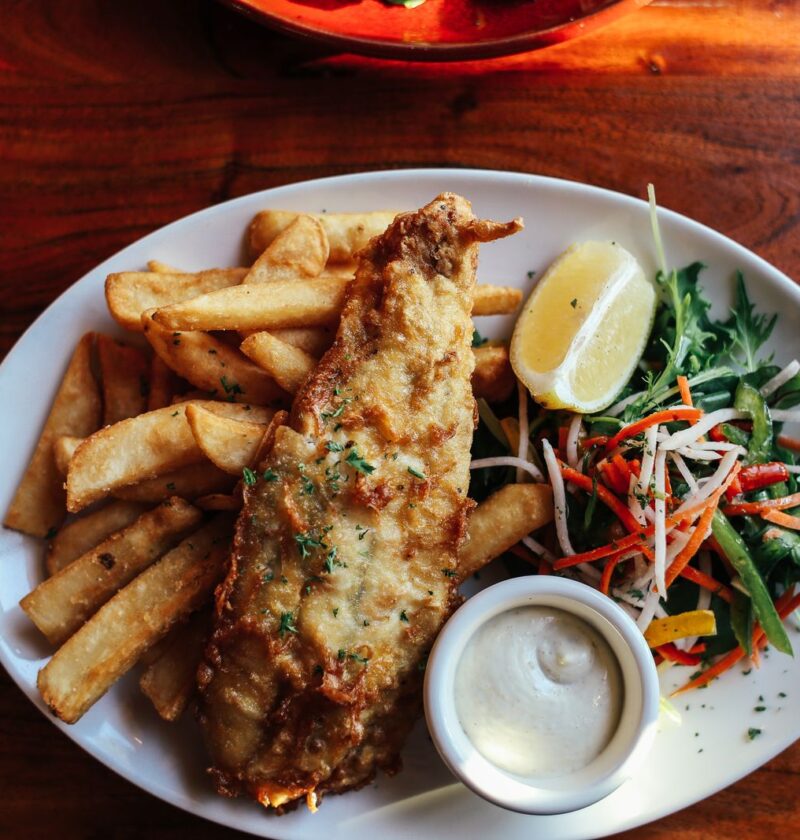


Fish and chips feels like a deeply British dish, yet its parts came from several places. Fried fish is usually traced to Jewish immigrants from Spain and Portugal, who reached England in the seventeenth century and fried fish in batter or flour, a technique that could be eaten cold on the Sabbath. Fried potatoes, or “chips”, were known in France and Belgium.
In the 1860s, the two came together. Accounts credit a Jewish immigrant, Joseph Malin, with opening a fish and chip shop in London around 1860, while another claim names John Lees, who is said to have sold them in Lancashire in the 1860s. As with many food stories, the claims are hard to prove.

Fish and chips fitted industrial Britain well. Steam trawlers brought in cheap fish from the North Sea, railways moved it inland, and workers in growing towns needed hot, cheap, filling food. By the early twentieth century there were many thousands of shops.
During the First and Second World Wars, fish and chips were not rationed, and the dish became linked with morale. It is sometimes called a national dish, though chicken tikka masala has also been given that title.
Today the meal is served with salt and vinegar, mushy peas and tartare sauce. Sustainability of fish stocks has become important, so many shops now choose cod, haddock and other species with certification.
The story in more depth
The fish part of the dish owes much to the sea. By the mid-nineteenth century, steam trawlers and the railway network, particularly the line from the fishing ports of Hull and Grimsby, carried fresh fish inland. Chip shops spread through the industrial north, and by the early twentieth century there were thousands. Customers wrapped their meal in newspaper, a tradition that ended for hygiene reasons in later decades.
During both world wars, fish and chips stayed off the rationing list, and Winston Churchill reportedly called them “good companions”. The dish became associated with comfort and national resilience. Different regions have their own traditions: in Scotland, you might get a “fish supper”, often with haggis or deep-fried Mars bars as a curiosity; in Yorkshire, many shops fry in beef dripping, and mushy peas and curry sauce are common sides.
Fish and chips was exported with British emigrants to Australia, New Zealand, Canada, South Africa and elsewhere. Overfishing of cod and haddock, especially in the North Sea, has made sustainability a growing concern, and organizations such as the Marine Stewardship Council have certification schemes. Some shops now serve pollock or other species.
A timeline
- 1600s: Sephardic Jewish immigrants bring fried fish to England.
- 1860s: The first fish and chips shops open in London and northern England.
- 1910: There are thousands of fish and chips shops across Britain.
- 1914 to 1918 and 1939 to 1945: Fish and chips stay off the rationing lists in both world wars.
- 1950s: Frozen fish and fish fingers become popular.
- 1990s: Concerns about overfishing lead to sustainability schemes.
- Today: The dish remains a national favorite.
Regional styles and variations
- Scottish fish supper: fish and chips served with salt and sauce.
- Yorkshire style: fried in beef dripping.
- Mushy peas and curry sauce: popular accompaniments.
- Battered sausage and pie: found at chip shops.
- Irish chipper: a chip shop tradition in Ireland.
- Australian “fish and chippery”: often serves flathead or barramundi.
Buying, tasting and choosing well
Good fish and chips should have crisp, light batter, flaky fish and chips that are crisp outside and fluffy inside. Look for shops that fry in clean, hot oil. Choose fish certified as sustainable, such as MSC-certified. Eat it fresh and hot, with salt, malt vinegar and lemon, and perhaps tartare sauce.
Did you know?
- Cod and haddock are the most traditional fish.
- In the past, the dish was wrapped in newspaper.
- Many British people eat fish and chips on Fridays.
- The batter is often made with flour and water or beer.
Eating it today
Fish and chips remain a seaside tradition. A good approach is to buy from independent shops that source fish responsibly, and to treat the meal as an occasional treat.
Countries connected to this story
- United Kingdom: the home of fish and chips, with shops in every town.
- Portugal and Spain: linked through the Sephardic Jewish tradition of fried fish.
- Belgium and France: from which the fried potato “chip” tradition is often traced.
- Australia and New Zealand: where fish and chips are a beach-side takeaway tradition.
- Ireland: with its own well-known chippers, such as Leo Burdock’s in Dublin.
- Iceland and Norway: major suppliers of cod and haddock.
Where to try it
- Rock & Sole Plaice (London, England): a Covent Garden fish and chip shop, often said to date to 1871.
- Harry Ramsden’s (Guiseley, Yorkshire, England): a famous chain that began in 1928 as a fish and chip hut.
- The Magpie Café (Whitby, England): a seaside café known for fish and chips with harbor views.
- Bryan’s of Headingley (Leeds, England): a long-running fish and chip restaurant.
These are well-known examples, not paid recommendations or rankings, and places change. Check opening times and details before you travel.
Well-known brands
- Young’s Seafood: a British frozen seafood brand.
- McCain: a frozen chips brand sold in the UK.
- Sarson’s: a British malt vinegar brand.
- Heinz: a global brand known for ketchup and sauces.
Brands are named as widely known examples of makers, not as endorsements.
Many food origins are disputed. This story summarizes commonly cited accounts as an introduction, not the final word.
Photo credits: Rachel Claire on Pexels; L. Lum on Pexels; Tara Winstead on Pexels. Free stock photos shown as illustrations only.